|
||||||||
|
THE 2004 IHSA NATIONALS CACCHIONE CUP COMPETITION Murfreesboro, TN - 29 riders competed in the 2004 IHSA Nationals' Cacchione Cup Competition, 19 of them doing so for the first time. 28 of the 29 competitors earned the right to compete in this division by accruing the most points (combined flat and fences) in the open division within their region during the regular season. One other rider, Stephanie Mitchell of Washington State University, was second in her region but gained the right to compete when Laura Hussey of the University of Washington incurred a riding-related injury while practicing for the National show. The Cup itself is named for Mario "Marty" Cacchione, father of IHSA Founder and Executive Director Bob Cacchione. The evolution of this class has changed somewhat since an award was first given in Spring of 1972. Duncan Peters of the University of Connecticut won the honor that season, though at that time the IHSA had existed for only five years, and Peters did not have to compete in a post-season class to win as the final regular season show WAS Nationals! The final show of the 1971-72 season was at Smoke Run Farm in Stony Brook, New York (regular season shows are still hosted at Smoke Run) and not only did Peters hold the lead over several others, his University of Connecticut team remained ahead of defending National Champion Stony Brook University (also known as the State University of New York at Stony Brook). The IHSA was one big region that season, encompassing schools in the states of New York, New Jersey, Connecticut, Pennsylvania and Massachusetts. The IHSA split into two regions for the 1972-73 season, and into three for 1973-74, the first year of a proper National Show. Hosted by Bucks County Community College at Peacefield Farm in New Hope, Pennsylvania, the 1974 National Show was made up of individual classes only, including a three-way competition for the top open rider. Marty Webster of Bennett College, representing Region 2 (essentially the current Zone 2, Region 2 and Zone 2, Region 3) won the class. Several years ago we at Campus Equestrian were (mis)led to believe that Webster was the third consecutive male rider to win the Cacchione Cup. However on 11/16/05 we were informed that Webster was in fact the first Female to win the cup (Duncan Peters of the University of Connecticut and Mark Weissbecker of the University of Massachusetts at Amherst had been 'given' the award in 1972 and 1973 respectively). Nationals continued to be made up of individual classes until 1979, when the first true team competition took place. By this time, six regions sent their top teams to IHSA Nationals, while six riders took part in what has been called the Cacchione Cup competition since 1992. Mary Buckley of Colby-Sawyer College won the high point rider division that year, making Colby-Sawyer the first team to have two riders who won the class (Susie Horrigan had won the division in 1976). Incidentally the 1978-79 season was the first for Western, though hunter seat and stock seat riders would not compete at the same IHSA Nationals show until the 1983-84 season. In 1982, CeCe Williamson of the University of Virginia became the first rider to win the class at consecutive National Shows. Williamson won the honor a third time in 1983. Perhaps the most famous rider to win the class won it at 1984 Nationals in Harrisburg, Pennsylvania, when Elizabeth "Beezie" Patton won the award. Patton rode for Southern Seminary College in Virginia, which was a two-year school. Now known as Beezie Madden, the Southern Sem graduate is currently the number one female rider in the world according to some. Madden placed first at the 2004 Olympic Trials and will finally get to ride in the Olympics later this summer in Athens, Grecce, perhaps the only accomplishment that had eluded her up to this point. She was best in a field of nine at 1984 IHSA Nationals for the record. Several of the winners who followed Patton/Madden during the decade went professional. Peter Wylde of Tufts University won the open class at 1986 IHSA Nationals, while Kelly Mullen of Stony Brook won as a freshman in 1988 and a senior in 1991, but missed some time inbetween with a basketball-related injury. Though her career as a professional did not reach the hights of Patton, Mullen or Wylde, those who were there at the time believe that Heide Bossow of Hollins was the superior rider while in college. Current Alumni rider Ashton Phillips (Virginia Intermont College, '89) refers to Bossow as "The Complete Package." The package was the top open rider at IHSA Nationals in 1985 and again in 1987. The start of the 1989-90 season ushered in the first year of the "Zones Concept." Up to this point riders who placed first and second in each individual class at Regionals advanced directly to Nationals. With 13 regions already in place, this meant there were 26 individuals in most classes! The Zone shows would allow the top three from each regions' Regional Show to advance to Zones and then reduce the field to the top two at Zones moving on to Nationals. The only division that was not affected was the Cacchione, where the top rider from each region would continue to advance directly to Nationals. In May of 1990, the IHSA was made up of 16 Regions (and seven zones). By May of 1997 the eight Zones contained 21 Regions, and for the first time the top team in each region did not automatically compete in the team competition at IHSA Nationals. A formula based on the number of hunter seat or stock seat riders in each Zone determined how many teams from that particular Zone advanced to IHSA Nationals. Again, the criteria for earning the right to compete at IHSA Nationals in the Cacchione Cup Competition did not change, which insured for the time being that at least one english rider from every region in the country would compete at the National Show. Following 1999 IHSA Nationals there was a movement to use the Zone Shows to eliminate some of the Cacchione and AQHA Cup riders, perhaps reducing the field to only two riders per Zone. After discussion of the matter at the 2000 IHSA winter meeting, the rules not only remained the same, the format for the Cacchione Cup class was brought into question. For several years in the 1990's, all Cacchione entries took part in the jumping phase. Only the riders with the highest scores were called back for testing on the flat (some years this could mean 15 riders received a callback, while on others it could be as few as eight). By 2002 Nationals, the rules changed back to essentially what the rule book says, that each Cacchione participant rides both on the flat and over fences. In 2002 the format had everyone jumping first, then flating in two separate heats. However the flat classes were divided into groups of 14, with riders from the low end of the jumping phase placed in the first flat division to see if any stood out enough to be promoted into the other section. All 14 riders were excused. The format at 2003 Nationals was an improvement. Each Cacchione qualifier would ride in one of two flat classes. The scores would then be posted. All of the riders would return the following morning for the jumping phase. The scores from the fences would then be posted. The judges would then decide how many riders would participate in a work-off, to be held the following morning. Last season the top ten riders through both phases were invited back for a test. One of the more interesting sidebars of the 2003 Cup Competition was that three of the ten riders in the work-off asked for and received re-rides. One of those riders was John Pigott of the University of Vermont, who went on to win the class. Though the first three riders ever to win the division were males, Pigott became only the sixth male (and first in nine seasons) to win the Cup. Pigott was one of nine riders who found themselves returning to the Tennessee Miller Coliseum in Murfreesboro, Tennessee to compete for the 2004 Cacchione Cup. The junior from Newport, Rhode Island finished roughly 20 points ahead of Dartmouth freshman Tim Malone for top honors in Zone 1, Region 2 (by contrast, Pigott had to rally to overtake Ellen Lampman of Colby-Sawyer during the 2002-03 season, as Lampman had a slim lead going into the final show). The riders who placed second, third and sixth in the 2003 Cacchione were also back for another attempt. Miami of Ohio sophomore Megan Palmer had placed second in 2003, while Jordan Siegel of Savannah College of Art & Design had placed third. Meredith Houx of Texas A & M was seventh in 2002, then sixth last season. The senior from Albuquerque, New Mexico was one of four riders in the division who had competed at IHSA Nationals as a freshman, sophomore, junior and now senior, through Houx did not ride in the Cacchione her first season. Kristen Schwieger of Centenary College and Missy Starr of Cazenovia College also rode at each of the four most recent National shows, though neither could claim four appearances in the Cacchione Cup Competition. University of San Diego senior Kate De Kraay was the only participant who could claim four consecutive trips to Nationals in the Cacchione. Though often mistaken as being the stereotypical blonde-haired, blue-eyed athletic California girl, De Kraay is actually from the Minneapolis suburb of Plymouth, Minnesota. De Kraay also has experience riding in "A" shows such as Lake Placid, and once competed in the Maclay finals at Madison Square Garden. Though she became the first rider in over a decade (maybe ever, we are still unsure) to qualify for IHSA Nationals four seasons in a row in the Cacchione Cup, her three previous appearances resulted only in participation ribbons. Could she break into the top ten - or even win - her last time out? One change that affected all the hunter seat classes at 2004 Nationals was the use of a "Pool" of stewards for hunter seat (rather than having the same three or four individuals steward all three days). There were seven rotating hunter seat stewards, each of whom sat inside a roped-off area near the judges. Utilized three at a time, the stewards were retired National Steward Tom Bishop; University of Cincinnati Head Coach Vance Copenhaver; St. Lawrence Head Coach Mary Drueding; Otterbein Head Coach Chris Eadline; At-large IHSA Board Member Jane Flynn, who has coached several IHSA programs; Cal Poly - San Luis Obispo Head Coach Sophie Rowlands; and Goucher College Head Coach Patte Zumbrun. According to the program there were only three stock seat stewards, so unless the number of western stewards was increased after the program went to print the traditional three-steward format remained in place for stock seat. The actual horse draw for this show is usually a spectacle in itself. This year was no different, as riders in all hunter seat classes had to pick one of 18 rubber ducks out of a contraption that allowed the ducks to flow around and around an artificial garden. The horse draw number was on the bottom of each duck, and riders were instructed to keep the ducks as a gift (One can only imagine whoever purchased these ducks walking into a novelty shop and asking for 300 rubber duckies!). The 14 riders in the first flat heat drew their horses and waited for their class to come. Section A took place in the early afternoon, with horses walking, trotting and cantering in each direction. Riders were asked to drop their stirrups among other things. After hunter seat judges John Roper and Sarah Good had seen enough, announcer Ken McAfee excused the class. Following the indivdual alumni flat, the riders in flat section B of the Cacchione performed the same routine as those who went an hour earlier. McAfee announced that the combined judges scores of Good and Roper would be posted at 3:30PM near the elevator, and sure enough, they were.
The high score in the flat phase belonged to Palmer, who was given an astronomical '96.' Palmer had led after the flat phase at 2003 Nationals as well. Ironically, Miami of Ohio freshman open rider Jennifer Hutson obtained more points on the flat at Zone 6, Region 2 regular season shows in 2003-04 than teammate Palmer, but the sophomore from Lake Bluff, Illinois used a large advantage in the fences to earn Region 2 high point open rider honors for the season. Erika Jewell, a sophomore from Pennington, New Jersey riding for Virginia Intermont College was close with a '95.' Carleton College sophomore Lauren Flexon had a '94,' while Connecticut College senior Vanessa Stevenson had the next best flat ride with a '91.' Both Kelsey Amedeo of Stonehill College and Jaime Jansen of Skidmore College received scores of '90.' All but Jewell and Amedeo had been in the second section. Defending champion Pigott received a score of '83,' lower than 14 others. Last season Pigott had the second highest score through the flat phase, though when he is on, his work over fences leaves the competition in the dust. The fences phase was the second class of any kind on day two of IHSA Nationals, coming right after the individual novice fences. It took an hour and 20 minutes for all 29 contestants to jump the fences, including two re-rides. The jumping phase started with generally tentative riding, as only one of the first eleven riders reached a score of '80.' IUPUI sophomore Bradley Wolkoff had started the class with that score, and for the longest time it was good enough for first. However eight riders would eventually do better. The tenth rider in the order of go was Palmer. Incredibly, she had not one, but two refusals. Considering her talent and accomplishments, the term "rider error" would hardly seem in order. Several of the riders this writer sat with during the class, including De Kraay, assumed Palmer would be getting a re-ride in a short time. Two riders later, University of Massachusetts senior Amy Lowrey received a score of '87,' easily the best up to this point. Lehigh freshman Jill Douglas went next, and shocked everyone with a score of '89.' De Kraay went 15th, and her hopes of the top ten appeared dashed when she was given a score of 69. But appearances can be deceiving and one should never assume anything. Stevenson went next, and scored an '85.' Houx followed Stevenson, and the aggie senior had the finest ride thus far, with a '92!.' Schwieger scored an '82,' becoming the fifth rider in the last seven rides to break 80. Pigott went next, and was not nearly as good as would have been hoped. Still the score of '66' somehow seemed wrong when compared with several of the riders who scored in the 60's among the first eleven attempts. After scores in the '60's for both Mitchell and Ohio University senior Jessica West (who started at the novice level as a freshman and later rode in team intermediate fences for the 2002 IHSA hunter seat National Champions) it was Tara Brothers' turn. The University of South Carolina junior was poetry in motion, scoring a '95,' which would turn out to be the highest jumping score. With her flat score having been an '89,' it appeared as though Brothers would be the leader headed into the work-off on Sunday morning. Following Brothers and going 23rd was Paige Hortman. The freshman who started the season with Delaware Valley College and spent the second semester taking courses for Utah Valley State College scored a '90,' which suddenly gave her a shot at the top ten (Many asked this writer how someone can attend Utah Valley State College and be part of a region that geographically falls inside the Northeast. Hortman takes aviation classes at a flight school in Northeast Philadelphia affiliated with Utah Valley State). Her flat score was only a '75,' so the remainder of the jumping phase would determine if Hortman would return. None of the remaining six rides produced a score higher than a '72.' The only questions that remained were if there would be any re-rides or testing. Though Miami of Ohio Coaches Jim and Gwen Arrigon campaigned for a re-ride, Palmer would not be granted a second try. The following day Palmer fell during the team open fences, and would be given a re-ride on that occasion. At least two individuals who saw both of Palmer's uncharacteristic jumping rounds said afterward that Palmer was more deserving of the re-ride in Cacchione jumping than in team open fences. For what it is worth, Palmer was fifth following her re-ride in the team class and later won the individual open flat outright. Though Palmer did not get a re-ride in the Cacchione, two riders in the division who had gone clean but had unimpressive scores were given re-rides! Though this writer could not confirm the reason behind Flexon's re-ride, De Kraay caught a break thanks to her sharp eye during schooling. The horse she drew, "P.T." had been warmed up over the fences by a rider using spurs. De Kraay however was told she could NOT use spurs to ride him. De Kraay was thus given a re-ride by the stewards on another horse, "Blue." This time De Kraay scored an '84,' which combined with her '85' on the flat made her a shoo-in for the top ten. Flexon's re-ride moved her score from a 61.5 (which would have been 27th in the jumping) to a '72,' which made her average an '83.' One of the stewards later explained that "technical reasons" made it manditory for De Kraay and Flexon to receive re-rides unless they didn't want them. It is competely possible that Flexon also rode "P.T." which would have paved the way for her re-ride.
With no further testing over the jumps, the riders waited to see what their posted combined scores would be and if they would be invited to the work-off. Judges Good and Roper could have taken as many riders as they would have liked, but very surprisingly issued a call-back to only five riders: Brothers of South Carolina (a '92' average), Houx of Texas A & M ('90'), Stevenson of Connecticut College ('88'), Lowrey of UMass at Amherst ('87,' the only rider in the competition with the exact same flat and jumping score) and Douglass of Lehigh (86.5). De Kraay would have been next with an 84.5 average. The good news for De Kraay was that she had finally made it inside the Cacchione top ten. The bad news was that she would not be able to move above sixth place. The Thursday or "opening day" schedule of classes had gone by in a hurry, with eleven classes completed in just over eight hours. The Thursday schedule was the first "all hunter seat" day at Nationals since 1983, the last year before english and western had a combined proper National show. As many had predicted, the western classes, each of which would have a pattern, caused the show to slow down considerably on Friday, so much so that the fourteenth and final class, the team open reining pattern, did not end until 10:24PM, eleven minutes shy of a 14 hour day! Some wondered if the decision to call back only five riders for the work-off was done to speed up the show. All indications are that this was NOT the case, as Roper and Good could use the '85' average as a cut-off for the right to be tested on Saturday morning. The third and final day of hunter seat classes started at 8:10AM with team open fences. Houx won the division, with a jumping score of '95.' Houx would be the only rider in both of the first two classes, as the Cacchione work-off followed. Houx, Stevenson, Douglass, Lowrey and Brothers returned to learn their test, which only employed two fences but required a rather abrupt halt. Douglass went first, and as Kutztown University Head Coach Bruce Lachiusa would later say, "She laid it down!" The other four riders were nearly as good, with perhaps Brothers having the next best go. Though the test involved only five riders, each of the riders who placed sixth through tenth (based on the average scores) returned in full attire to be presented with their ribbons.
Tenth place went to Hortman, the freshman from Newtown, Pennsylvania averaging an 82.5. Flexon was ninth, while Jewell, who had been the hero for Virginia Intermont in the team competition an hour earlier, was eighth, averaging '84.' Wolkoff, the first non-Purdue rider from her region to compete in the Cacchione since the last millennium, became the first Indiana University - Purdue University at Indianapolis rider ever to place inside the Cacchione top ten. Wolkoff was seventh, also with an average of '84' but ahead of Jewell when the tiebreakers were applied. De Kraay was obviously sixth, while Houx was the first of the top five to hear her name announced. Having now placed seventh in '02, sixth in '03 and fifth in '04, Houx said it is doubtful she will ride alumni, though she will definitely remain in the horseworld. We are still counting the classes in the past four Nationals programs to see in anyone else had as many hunter seat rides as the senior from Albuquerque. Fourth place went to Connecticut College's Stevenson. Though she had a storied background before ever riding in the IHSA, the brutal Zone 1 Zones shows had knocked Stevenson out of the running individually on an annual basis. Brown's Amanda Forte won the right to compete in the Cacchione out of Zone 1, Region 1 both Stevenson's freshman and sophomore seasons, while Jamie Peddy of Brown finished in a tie with Stevenson for the Region 1 top spot in 2003. A ride-off at April '03 Region 1 Regionals went to Peddy, but in 2004 Stevenson finally was ahead in the Region 1 open rider standings at the end! It would have been one of the great crimes of all time if Stevenson did not at least get one shot at a prize at Nationals. Like Houx at A & M and De Kraay at San Diego, it will be hard to imaging Conn College without the senior from Southampton, New York next season. The somewhat quiet but very talented Amy Lowrey was third. Lowrey has been a mainstay in the open division within Zone 1, Region 3 for the past three seasons. In '02 she was third overall, then fifth in '03. From Armonk, New York, Lowrey finished eight points ahead of Mount Holyoke's Kyla Makhloghi for the right to ride in this class at Nationals. Her quiet riding in the test may have helped her leap over Houx and Stevenson, as both had higher average scores coming in. Lowrey may have one more semester of eligibility at UMass, so it is conceivable that Lowrey could be at Nationals again, though her third in the 2004 Cacchione Cup will probably be her final ride in that division.
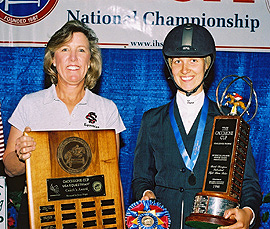
Douglass had the uncomfortable honor of having to go first in the work-off. In contrast to most who go first, Douglass rode like she had been performing this particular test for years. The freshman from Pittsburgh, Pennsylvania moved from fifth to second with the ride, becoming the reserve National Champion in the Cacchione Cup. Douglass became the first rider from Zone 3 to finish as high as second in the Cacchione Cup since Sayre Brookreson of Temple did likewise during 1997 Nationals at Mount Holyoke. Douglass had finished ten points ahead of Kutztown's Ashley Force (also a freshman) in the Zone 3, Region 4 open rider standings, though that race had gone down to the final regular season show. The final name to be announced by McAfee was that of Tara Brothers, the South Carolina junior from Bend, Oregon. Brothers' combined score of 92 coupled with no worse than the second best test gave her the Cacchione. During the regular season, Brothers finished 12 points ahead of Amy Humble of Berry College for the right to compete at Nationals in the Cacchione contest. Though she posted only 60 points (combined flat and fences), it should be noted that Region 2 of Zone 5 staged only seven regular season hunter seat shows, and Brothers was the only rider to qualify for Regionals in both open divisions. The team race was VERY close in Region 2, with Berry finishing ahead of South Carolina by a 228-225 score. Though Berry will try to win the region for the third time in four years come fall, it would not surprise many if Brothers and Head Coach Boo Major Duncan were able to sneak the gamecocks past the vikings by the time the 2005 post-season rolled around. ---Steve Maxwell Combined Flat Scores, followed by Combined Fences Scores: Kelsey Amedeo, Stonehill College - 90/67 (78.5 average) Alex Ansteth, Colorado State University - 79/63 (71 average) Laura Blau, University of California at Davis - 85/55 (70 avg.) Tara Brothers, University of South Carolina - 89/95 (92 avg.) Dehlia Burdan, Kansas State University - 84/62 (73 avg.) Destiny Caldwell, C.W. Post College (Long Island University) - 80/70 (75 avg.) Lydia Davies, Goucher College - 87/68 (77.5 avg.) Kate De Kraay, University of San Diego - 85/84 (84.5 avg.) Jill Douglass, Lehigh University - 84/89 (86.5 avg.) Lauren Flexon, Carleton College - 94/72 (83 avg.) Allison Handler, Penn State University (State College) - 74/72 (73 avg.) Paige Hortman, Utah Valley State College - 75/90 (82.5 avg.) Meredith Houx, Texas A & M University - 88/92 (90 avg.) Jaime Jansen, Skidmore College - 90/74 (82 avg.) Erika Jewell, Virginia Intermont College - 95/73 (84 avg.) Caitlin Lane, Washington & Lee University - 70/78 (74 avg.) Amy Lowrey, University of Massachusetts at Amherst - 87/87 (87 avg.) Stephanie Mitchell, Washington State University - 70/62 (66 avg.) Megan Palmer, Miami University of Ohio - 96/20 (58 avg.) John Pigott, University of Vermont - 83/66 (74.5 avg.) Kristen Schwieger, Centenary College - 81/82 (81.5 avg.) Jenny Sharon, University of Montana - 74/47 (60.5 avg.) Lindy Sibel, Western Michigan University - 77/65 (71 avg.) Jordan Siegel, Savannah College of Art & Design - 77/75 (76 avg.) Missy Starr, Cazenovia College - 85/71 (78 avg.) Vanessa Stevenson, Connecticut College - 91/85 (88 avg.) Dionne Stigge, Middle Tennessee State University - 72/61 (66.5 avg.) Jessica West, Ohio University - 72/60 (66 avg.) Bradley Wolkoff, Indiana University - Purdue University at Indianapolis - 88/80 (84 avg.) 2004 CACCHIONE CUP PLACINGS: 1. Tara Brothers, University of South Carolina 2. Jill Douglass, Lehigh University 3. Amy Lowrey, University of Massachusetts at Amherst 4. Vanessa Stevenson, Connecticut College 5. Meredith Houx, Texas A & M University 6. Kate De Kraay, University of San Diego 7. Bradley Wolkoff, Indiana University - Purdue University at Indianapolis 8. Erika Jewell, Virginia Intermont College 9. Lauren Flexon, Carleton College 10. Paige Hortman, Utah Valley State College
|
||||||||
|
|
||||||||
|
HOME
| CONTACT US |
||||||||